
You are here:HOMEPRODUCTSAcid/Alkali Gas Treatment
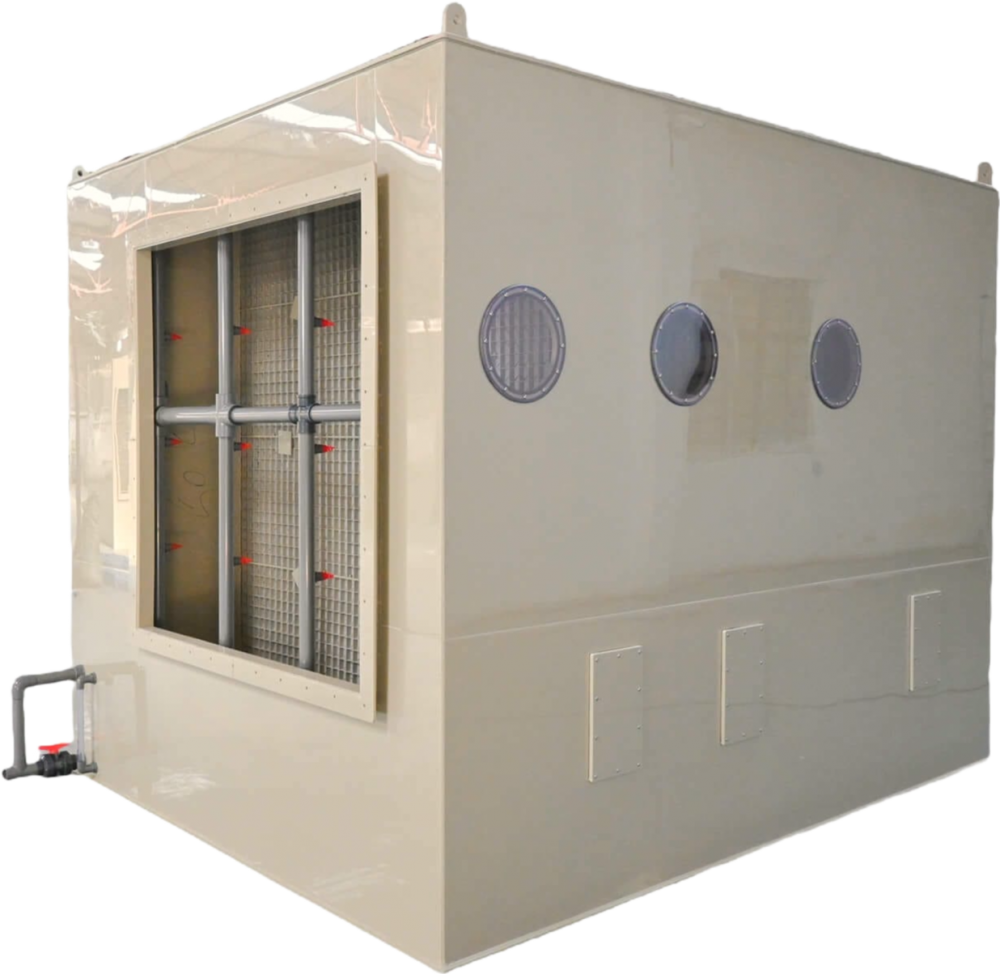
Brief Description: PP/PPS horizontal spray tower for high-airflow acid and alkaline gas treatment, with seven standard models from 5,000 to 50,000 m³/h.
Details
The PP/PPS horizontal spray tower is a corrosion-resistant crossflow wet scrubber designed for high-airflow acid and alkaline exhaust treatment. Its low-profile rectangular structure is well suited to installations with limited vertical clearance. Standard models cover airflow capacities from 5,000 to 50,000 m³/h, with custom dimensions and connections available for specific process and site requirements.
Exhaust gas flows horizontally through the packing bed while the scrubbing solution is sprayed downward from above. This crossflow contact provides a large gas-liquid contact area, allowing soluble pollutants to be absorbed and neutralized by the circulating solution. Captured contaminants drain from the bottom of the unit, while the treated gas exits through the horizontal outlet.
▪ PP or PPS construction provides excellent resistance to corrosive gases and chemical solutions.
▪ Horizontal crossflow design supports large airflow volumes with a relatively low equipment height.
▪ Packed-bed and spray contact improves absorption and neutralization of water-soluble pollutants.
▪ Seven standard models cover airflow capacities from 5,000 to 50,000 m³/h.
▪ Suitable for acid mist, alkaline gas, nitrogen oxides, and other corrosive industrial exhaust streams.
▪ Dimensions, duct connections, pump capacity, and treatment stages can be customized.
Horizontal spray tower technical data (PP construction)
↔ Swipe horizontally to view all specifications.
The PP/PPS horizontal spray tower is suitable for electroplating lines, metal surface treatment, acid pickling, chemical processing, semiconductor and electronics production, laboratories, wastewater treatment facilities, and other applications requiring high-airflow treatment of corrosive or water-soluble exhaust gases.
Technical data is based on the standard PP horizontal spray tower configuration. Final dimensions, materials, treatment efficiency, and auxiliary equipment are determined according to the actual gas composition, concentration, temperature, airflow, and site conditions.
 Scan with WeChat