
You are here:HOMEPRODUCTSAcid/Alkali Gas Treatment
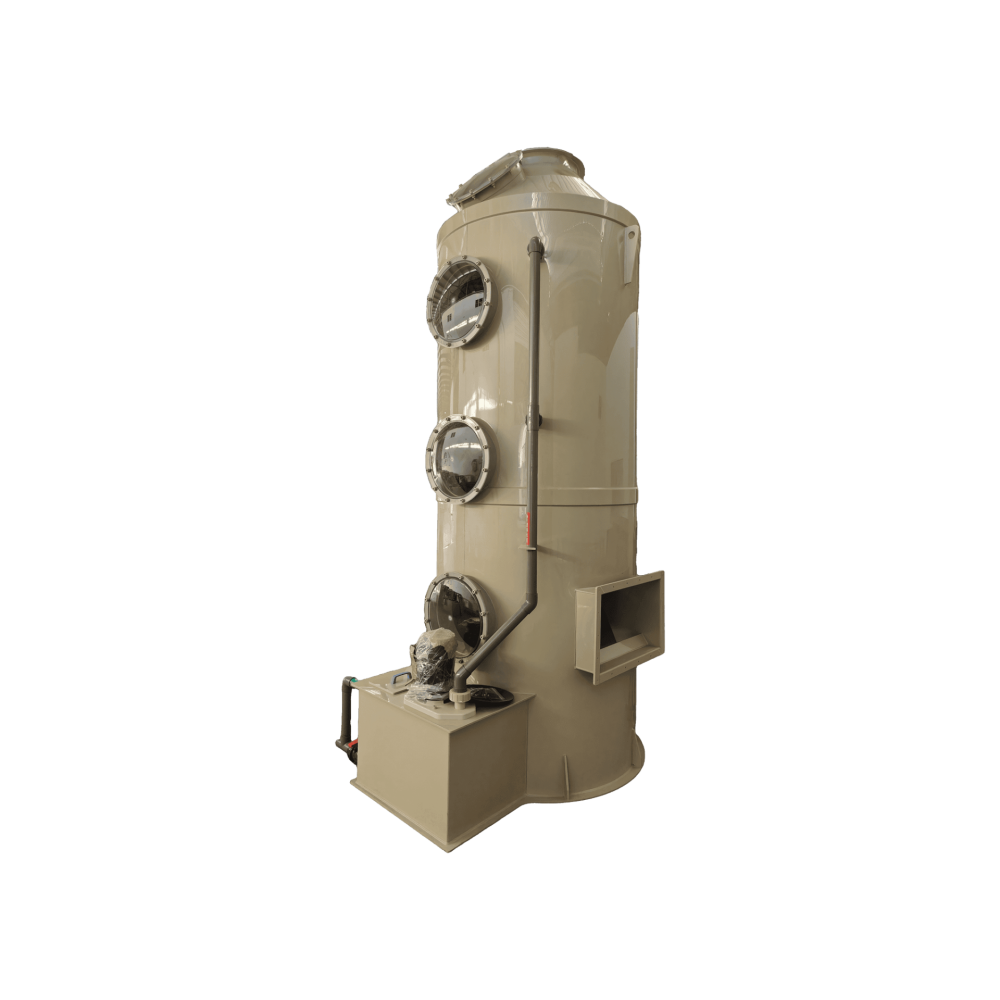
Brief Description: Corrosion-resistant PP/PPS vertical spray tower for acid and alkaline gas treatment, with customizable airflow capacities from 4,400 to 63,600 m³/h.
Details
The PP/PPS vertical spray tower is a corrosion-resistant wet scrubber designed to remove acid and alkaline gases from industrial exhaust streams. Its vertical counter-current design provides efficient gas-liquid contact while keeping the equipment footprint compact. The tower can be customized to suit different airflow rates, contaminants, installation conditions, and process requirements.
Contaminated gas enters the lower section of the tower and flows upward through the packed bed. At the same time, a neutralizing solution is sprayed downward and recirculated through the packing. The large contact area allows soluble pollutants to be absorbed and chemically neutralized. The captured contaminants leave with the circulating liquid, while the treated gas passes through the mist-removal section and is discharged from the top of the tower.
▪ PP or PPS construction for excellent resistance to corrosive gases and chemical solutions.
▪ Counter-current gas-liquid contact for stable absorption and neutralization performance.
▪ Compact vertical structure suitable for sites with limited floor space.
▪ Multiple standard sizes covering airflow capacities from 4,400 to 63,600 m³/h.
▪ Customizable dimensions, inlet and outlet configuration, pump selection, and treatment stages.
▪ Suitable for acid mist, alkaline gas, nitrogen oxides, and other water-soluble industrial pollutants.
Vertical spray tower technical data (PP construction)
↔ Swipe horizontally to view all specifications.
This vertical wet scrubber is suitable for chemical processing, electroplating, metal surface treatment, semiconductor and electronics production, laboratories, pharmaceutical plants, wastewater treatment facilities, and other processes that generate corrosive or water-soluble exhaust gases.
Technical data is based on the standard PP vertical spray tower configuration. Final dimensions, materials, treatment efficiency, and auxiliary equipment are determined according to the actual gas composition, concentration, temperature, airflow, and site conditions.
 Scan with WeChat